Organization Founder Helps Grievers Live Through Loss
Part Two
By Luke Schmaltz, VOICES Newsletter Editor
As the founder of Living Through Loss (LTL), Jamie Eaton has spent the last seven years providing individual and peer grief support to bereaved parents. Her programs address grief through a system of six-week sessions for people in their first, second, and third years of grief. Eaton’s programming also addresses future challenges that a bereaved parent in long-term grief may encounter.
In Part One, Eaton discussed why group dynamics, finding balance, and reinvesting in community are vital elements for people who are living through loss. Here, Eaton delves further into reinvesting in community, the open-source offering of her system, and specific therapeutic practices in her programs.
Up Close and Personal
“Something we do that is very helpful,” Eaton continues, “is that we host a lot of in-person events. For example, for International Overdose Awareness Day (IOAD), we host what we call The Favorites Brunch. Bereaved parents bring their child’s favorite food, and we have a potluck. I make a playlist of the favorite music of each parent's kids, and we spend the afternoon eating and telling stories. It’s a really great way to engender continuing bonds. I have a favorite quote from the movie Steel Magnolias, ‘My favorite emotion is laughing through tears.’ We say that a lot, and we do that a lot.”
Eaton emphasizes the importance of presenting a variety of ways for grieving parents to reinvest in their communities. “We present as many projects as we can,” she continues. “For example, there is a dad in our community who preps hand-sized rocks to be painted upon. We get together, and everybody paints inspirational sayings and images on those rocks. That activity is very important to this dad, and it is his contribution to the community.”
Living Out Loud
“We also have a speaker series. There is a group of parents in our community who like to go out and speak at recovery centers, such as Brooke’s House, where I work. They come in and share their stories with the women here, all of whom are in recovery. It is good for both sides, because the LTL parents get to offer the residents lots of encouragement and love, and tell them to let go of their shame. They can offer the residents what their families may not be able to, and the residents get to give love back to the speakers. We also speak in rotary clubs, IOAD events, and residential treatment centers.”
“We often refer to the saying, ‘Grief is love with no place to go.’ Reinvesting in your community is love you can’t give your child, but you can offer it to someone else, and the load lightens when you do that.”
Giving is Receiving
Eaton’s generosity extends beyond the elements within her program to the program itself. “For anyone interested in starting a program like LTL, I would encourage them to call me,” she says. “I am willing to hand off the entire curriculum to anyone who wants it. I will give all my program materials to any therapist who wants to implement them. We are a small organization, but we want to serve as many people as we can. If somebody wants to do this work, I will help them get set up.”
“The challenge for therapists who want to run something like LTL is the funding piece,” Eaton explains. “Grant writing is no joke. If you can find someone who is in charge of an endowment or who can make a private donation, you are freed from grant writing. For a parent who wants to do something like this, I would encourage them to ask themselves what they are passionate about and what they love, and to follow whatever that might be. That could be offering support to other bereaved parents by simply meeting with them at a coffee shop and listening to them.”
Small to Mighty
“Living Through Loss started small, out of a need. It was never my goal to do LTL at this level, but I am thrilled that it has grown to this point, and I love doing this. I didn’t set out focused on step 10. I took it one step at a time, and that’s how we got here. Anytime a need arose that was in line with the mission, we rose to the occasion and met that need.”
“For our Zoom groups, we keep them at a maximum of eight, and we run them quarterly, but I would like to run them more often and would happily do so 10 or 12 times a year. We have reached pretty much everyone in our area and within the scope of my social media capabilities. That’s why I recently went to the Compassionate Friends Conference to get the word out to a broader audience.”
Healing Horses
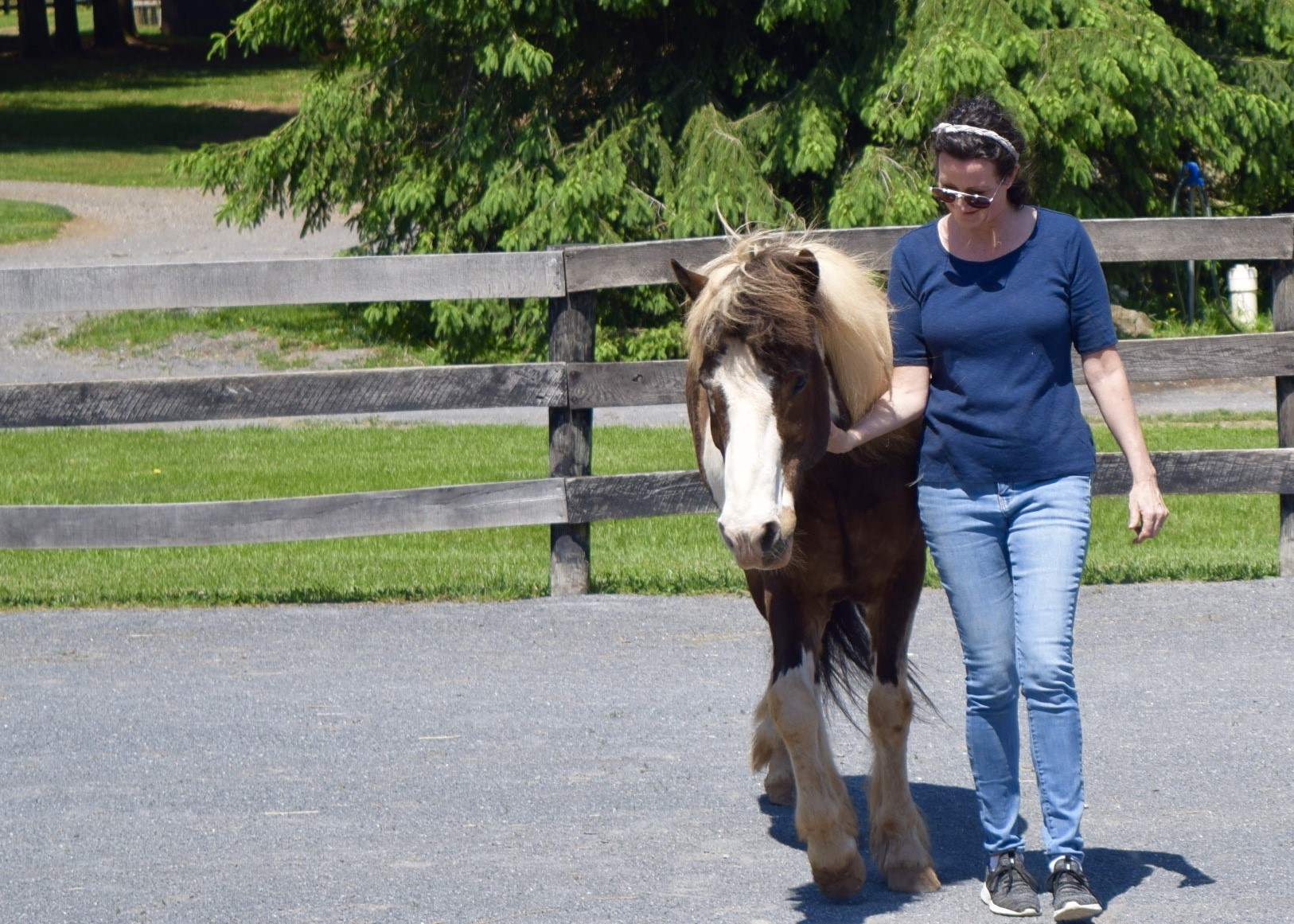
“We also do a lot of equine therapy,” Eaton continues, “And I am currently developing an equine program for Brooke’s House. For LTL, we offer equine therapy focused on being in the presence of the horse. Horses are prey animals; they are very vulnerable, they are always on alert, and they are super intuitive. We find that the best approach is to put parents in a ring with horses and see what happens. Usually, what happens is that a parent will regulate off the horse and feel free to let their grief flow.
“We tell them things like, ‘Horses keep secrets, you can tell the horse whatever you need to.’ We encourage them to pet the horse, put their hand on their lungs, and match their breath to that of the horse. You can regulate off a horse just like you regulate off a person. It is a very simple, yet very powerful approach.”
“Another thing we do in equine therapy is to tell a participant to choose from a variety of materials and make an obstacle course that represents their grief journey. Then, we have them lead the house through that obstacle course and allow for free association. As they walk through it with the horse, it feels like they are going through their journey, accompanied by a spirit animal.”
“There’s a Japanese word, wabi-sabi, which means to have two conflicting emotions at the same time,” Eaton concludes. “It is like experiencing grief and joy at the same time – laughing through tears.”