Grieving Mother Helps Underserved Communities
Part One
By Luke Schmaltz, VOICES Newsletter Editor
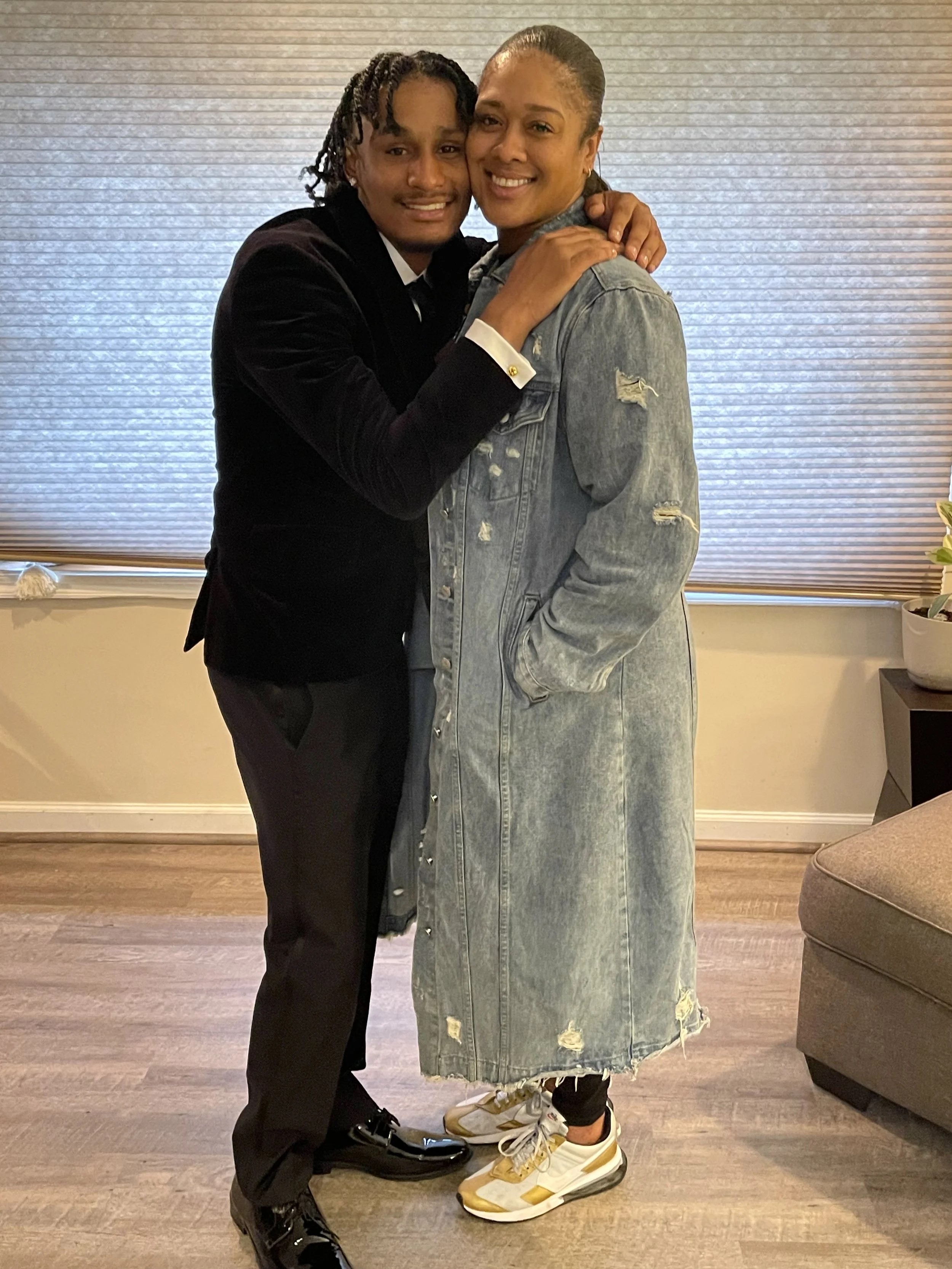
Kimberly Douglas is the Founding Director of Bryce’s Treehouse and the driving force behind Black Moms Against Overdose.
On June 23, 2023, Douglas’ 17-year-old son, Bryce Jackson, died from fentanyl poisoning. Bryce had recently graduated from high school and was just five days away from his 18th birthday. Shortly before he died, Bryce was diagnosed as high-functioning autistic – otherwise known as Asperger’s Syndrome.
Seasonal Struggle
“I am going into what I call ‘Bryce’s Season,’” Douglas begins. “I’ve lost loved ones, grandparents, uncles, and cousins, but this is on a whole different level. This time of year is really hard. In the spring of 2023, we went from prom season to graduation to Mother’s Day and then on vacation to his favorite spot in Rehoboth Beach, Delaware. We were getting ready to celebrate his graduation with a party on June 29. Instead, we ended up doing a vigil on the 28th, his birthday.”
“Bryce was experimenting with marijuana through COVID,: Douglas recalls. “When school opened back up, he met a girl, and they started experimenting with pills. I found him when he was at home with me on a Friday. He kept telling me that he was anxious; meanwhile, I was working, but I only had half a day of work to get through. I told him to give me a little time to wrap up my duties, and then we would figure out whether or not he needed to go to work that evening.”
“He walked out the door, and I heard my phone ping because we share an Apple ID. I saw that he had sent somebody some money through Cash App. I questioned him about it, asking him if he bought pills because it was a lot of money. He said that he did not, that he bought weed, and that he was going to sell it, and so forth. I said that no, he was not going to do that for all obvious reasons. He came into my office and said that he wanted to spend time with me, and I suggested that he go into his room and take a nap. I laid him down, kissed him, and said, ‘I love you, I’ll wake you up when my work day is over, and we ‘ll figure out the rest of our day.’”
“About an hour later, I went into his room to wake him, and he was purple and drooling. I freaked out and ran into the kitchen to look for the Narcan. I got on the phone with the 911 operator, and I started doing chest compressions. It felt like 30 minutes, but it was only 7 minutes before the ambulance arrived. As I was running out of the room to let them in, I touched his foot, and I knew he was gone.”
Searching for My People
I founded Bryce’s Treehouse because after Bryce died, I had a strong urge to find other families who had experienced what I had. I went online and ended up meeting a lot of moms who were proponents of drug-induced homicide. This is when a prosecutor charges someone with manslaughter or murder who supplies drugs that result in a fatality. That connected me with Lost Voices of Fentanyl, and I realized that this was not the right lane for me. I didn't feel like the people I was meeting shared my values.”
“When I realized I was not in the right place, I reached out to a gentleman named Ethan Nadelman, who started the Drug Policy Alliance. I went to their conference in the spring of 2024, and Ethan put me in touch with Cassandra Frederique, who is now his successor.
“She put me in contact with Vital Strategies, which at the time was running a campaign around saving lives. Their messaging highlighted the fact that, while the number of overdose deaths is lowering in general, for black and indigenous communities, they are rising. They identified seven cities around the country where the number of overdose deaths is rising for black, brown, and indigenous folks. We had a series of conversations about that, which are available on Bryce’s Treehouse website.”
“I also got linked up with the National Black Harm Reduction Network, which is how I came up with the idea of creating Bryce’s Treehouse. I realized that I needed to focus on the fact that, of all the groups I reached out to after Bryce died, none of the people involved looked like me. Of all the support groups I attended, there was not a lot of brown and black representation.”
Pinpointing Disparity
“The lack of ethnic representation in support groups struck me as odd. I live in Prince George’s County, MD, which is one of the most affluent counties for black people in the country. I didn’t hear anything about fentanyl in this county. All of the support groups I was in had people from every other country outside of Prince George’s.”
“Having worked in progressive politics for 17 years, I knew a lot of philanthropists who were giving to good causes. I figured that I could use my network to have donors funnel money to other groups on the ground, who are actually doing this work, in black, brown, and indigenous communities. That is essentially what Bryce’s Treehouse does, and we also have a local lens because there was nothing happening in Prince George’s County.”
“I think that many people in underserved communities are not finding support when a loved one dies from substance use. I believe there is some support within some communities. I managed to meet another black mom at the Drug Policy Alliance Conference we went to last year. Her name is Terika Carter, and she lost her son in 2020. She started the very first syringe program in Charlotte, NC. It is called Hajee House and she serves her community by making sure people have clean syringes, providing drug testing, and feeding people who are unhoused. That is what I am hoping Bryce’s Treehouse can become in addition to being an arm for helping people find other similar groups.”
“I am also finding out that, in my county, there is not much movement around the opioid settlement money. After talking to the Opioid Task Force, I found out there is only one opioid treatment center in my county, and it is nowhere near me. I talked to the health department last week, and I told them I am going to start making trouble in this county because it doesn’t make sense that there is no Narcan or naloxone available. My daughter and I recently went looking for those things, and the pharmacist at CVS looked at us like we were crazy – they had no idea what naloxone was.”
Finding Support
“I have a friend named Beth Schmidt who lost her son 11 years ago to 100% fentanyl,” Douglas continues. “She runs a small support group called Our Healing Hearts Support Group, and her organization is called the Maryland Heroin Awareness Advocates. The other group I am involved in is called SOUL (Surviving Our Ultimate Loss) in Rockville. It was established by five moms who lost their kids around 10 years ago. There are 50 or 60 of us in that group, but again, I am the only black mother in that group. The other group I attend is based in Frederick, and it is called Living Through Loss. They have virtual support groups, and they work with parents who have lost children to overdose.”
“I don’t know how I would be maneuvering through this loss without those support groups,” Douglas attests. “Which is why I find it odd that it is rare to meet someone who looks like me in a support group. I went to Living Through Loss’s annual conference a couple of weeks ago. There was one other black mother who showed up, and we both looked at each other like, ‘Oh my God, it does happen to other black people!’”
“That’s how Black Moms Against Overdose came about. It is a private Facebook page designed to reach out to other black families who have suffered a similar loss. It is intended to help us support one another and to try to understand why the stigma is so deep and why we refuse to talk about it. One of the reasons for this became clear to me the day after Bryce passed away. One of my relatives called me and said, ‘I am so sorry for your loss. We all loved Bryce. You don’t have to share how he passed away.’ That brought me back to the fact that my parents are both from the South. I had cousins who struggled with mental health and substance use, and my parents and I never talked about it, ever.”
“If we don’t talk about these issues, then we don’t know what needs to be addressed, nothing changes, and nobody heals,” Douglas attests. “It’s like the stigma around black men not wanting to seek therapy – black people in general. The stereotype says that black people don’t go to therapy. If we don’t go to therapy, how are we going to help each other?”
“I feel like where I am is a full circle combination of everything I am supposed to be doing in my life. My children’s father has mental health and substance use issues. I had to deal with that in my 20s and then with Bryce’s struggles in my 40s. I always knew I would work somewhere that dealt with mental health and substance use, but I didn’t realize it would be to such a degree.”
In Part Two of this Story, Kimberly Douglas shares more about her son’s struggles, the extended support community around Bryce’s Treehouse, and the challenges faced by the black, brown, and indigenous communities. Stay tuned to the July issue of VOICES for the rest of the story…