
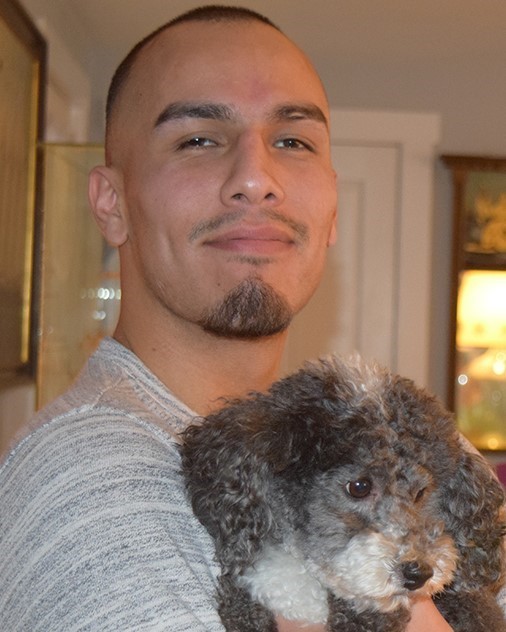
Bereaved Father Helps Others Cope with Anxiety and Grief
Part One
By Luke Schmaltz, VOICES Newsletter Editor
Tom Flanagan is the founder of Blue Skies, a Rhode Island-based organization dedicated to helping people find effective ways of coping with anxiety. The organization provides support and access to a local network of alternative care providers.
Blue skies recognizes that anxiety is a gateway to a host of behavioral health challenges, some of which can be deadly.
Flanagan’s outreach was the result of witnessing his son, Alex, struggle with General Anxiety Disorder which drove him to substance use. Along their journey, Flanagan identified a severe lack of accessible resources for coping with anxiety. On February 20, 2022, Alex died from a fentanyl overdose.
Onset Anxiety
“Alex struggled with behavioral health issues – ADHD – since grade school,” Flanagan begins. “As a parent, the notion of being able to treat ADHD with a pill was a very pleasant idea.”
“We adopted our two sons from Ecuador,” Flanagan explains, “And brought them into the flagship school district in Rhode Island. After having served as a member of their school board for a number of years, I callously quipped that we were the tallest of the seven dwarves, as we are adjacent to Massachusetts where there are many fine schools as well.”
“The bottom line from that experience is that an excellent school can be great for an excellent student and it can be hell for anyone else. If someone is struggling and they realize they are not keeping pace with their peers, they figure it out quickly – which gives rise to anxiety. I had no real understanding that anxiety is far more dangerous than ADHD, which is like a hunter’s mind in a farmer’s community. Anxiety is something that gnaws at you when it is chronic. I did not understand that as a father.”
“For example, when Alex was asking to go to the skate park on a Saturday to drop in off a 20-foot halfpipe, I thought he was seeking reward for having a good week when in reality, he was seeking relief from having a bad week. I mistook it for a reward, a healthy form of self-managing anxiety.”
Parallel Struggles
“I was alongside Alex for a decade dealing with various legal and health concerns. He was between jobs during Covid, and I suggested that he go to behavioral health support groups. I later learned that in that environment, when someone was having a hard time, Alex was the guy who would go up, wrap his arm around the person, and say, ‘Look, we are going to get through this.’”
“It still hurts me to realize how keenly aware he was of other people’s struggles. My experience was quite different. My anxiety pushed me to be an overachiever in the world of academics. In that world, the longer you stay in, the more thoroughly institutionalized you become. I couldn't see the earth I was walking on because my head was in the clouds as I was connecting with Nobel Laureates and people who were distinctly established in their careers. I had a sense of significance and position as well as a sense that I knew what mattered in the world.”
“Anxiety also caused me to overeat, so I had a weight problem. I have since lost about 130 pounds, so I feel much better. I had a carbohydrate addiction, which was explained to me by a nutritionist. If there is a last piece of pizza left, I don’t ask myself if I want it, I ask myself why I would not want it. My addictions blinded me to those of my son, and as clever as I thought I was, I didn’t have a clue as to what anxiety felt like from the other side of the table. Alex did everything I asked him to try, but I know in his heart he was saying, ‘Yep – here’s another way I can disappoint my father.’”
“When Alex died, there had been 10 years of ups and downs – some of it was pretty dark. He had a good job, and we subsidized the house he was living in, but the good job turned bad and he lost it. His living situation was more than he could manage so he turned to the circle of people who were giving him street drugs and got into the business of selling them.”
Reaching Out
“People don’t realize that there are resources all around them for managing anxiety. That’s not to say that everyone who offers an art class or a yoga class does so with a sense of what anxiety is. But there are people with lived experience in coping with anxiety who are operating in those areas. They are teaching from the perspective of someone who has lived with it and dealt with it.”
“After I lost Alex, I went to the local recovery center, and I spoke with someone named Tommy Joyce. It didn’t take much for him to convince me that there are wonderful people in the world. He lived through substance use and recovery and provided outstanding support for my son.”
“I explained to him that I was in a bad way, and I wanted to do something with my grief. I wanted to help other parents understand what anxiety looks like from an outside perspective. I also wanted to help people identify where to find local, alternative, complimentary care. The type of care that doesn’t require insurance, which doesn’t cost much, that doesn’t have a long waiting list, and that can offer immediate relief.”
“Tommy said it was a great idea and that anxiety is at the core of most recovery issues. He said it is at the heart of the current prevention programs. Before someone is in an anxious state, they are in a pre-anxious state where they might start self-medicating because chronic anxiety, like acute anxiety, causes one to look for ways to reduce the pain. That was the spirit behind the creation of Blue Skies.”
“Everyone I spoke to agreed it was a good idea, but they punctuated it by saying, ‘Good luck.’ Essentially, they were telling me to buckle my seat belt because it was going to be a long ride. They said this because it isn’t easy to convince people to deal with something that has not yet become a crisis. Once something becomes a big problem, dealing with it is a big problem.”
Civic Grief
“Right now, we are dealing with something called civic grief,” Flanagan says. “It isn’t spoken about very much, but it is a topic I am trying to get the New Bedford newspapers to make a campaign on. Civic grief is grieving for the lost reality around you – the longing for a way to recover the closeness and the sense of community you once knew.”
“Many people are grieving the loss of something, a path forward, a way home. There is an undercurrent of longing, we don't know what it is, but everyone is feeling it. This tide of grief is a great opportunity.”
“A lot of people who turn to a political solution for their only representation are feeling that type of grief as well. Grief for the loss of the world they thought they were going to raise their families in and their grandchildren were going to grow up in. It is a very unnatural world we are living in.”
“We are flooded with information, and we don’t have chances to sit back and relax together thoughtfully and compassionately and realize that the differences we might fear are the opportunities we could capture.”
From the Ground Up
“The experience of this grief shattered my sense of who I was and brought me to the ground entirely. It opened up an entirely different life for me because I realized that there is a whole economy out there that is not based on dollars, it is based on love. It is based on the fact that some people really care. Alex brought me into that world which, in many ways, saved me.”
“People can live their lives without ever knowing that there is this whole different economy of those who are connecting with others to help them. It is a very beautiful world. Some might say that it is currently fragile, but I believe it is growing stronger, although it is under pressure and stress from losing resources.”
“This is how I came into creating Blue Skies. It is not yet a corporate entity, it is a project. I would like to have people come in and decide they would like to be a part of it, if it is something that helps them recover from loss and manage their own grief.”
“I’ve been doing lots of reading on grief and I believe there is grief and then there is mourning. You can’t stop the pain, but you can stop the suffering. Grief is going to cause pain, but the way you mourn can cause you to suffer. This is true if you are surrounded by people who are telling you to ‘just get over it’ and that ‘it has been a while and it’s time to move on.’ This is also true if you are not taking care of yourself, not staying active, not staying healthy, letting yourself go, and blaming yourself for what happened. Then, you are torturing yourself and that type of suffering can be alleviated through peer grief support.”
“The metaphor that has been most effective for me is that pain doesn’t get smaller, life gets larger. You grow around the grief and learn to carry it; you never truly want to put it down. You don’t want to forget.”
Part Two of this story will explore the many resources available through Blue Skies, Tom Flanagan’s work with East Bay Recovery Center, peer support for grief and anxiety, and more. Please stay tuned to the December issue of VOICES for the rest of the story…