
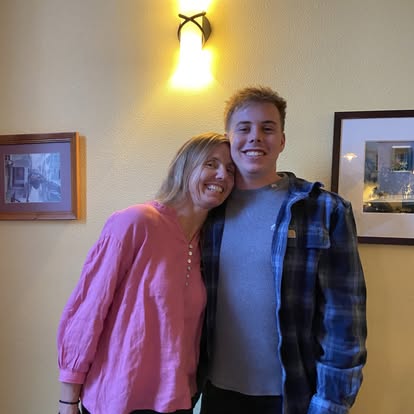
Katie Rizzo applies an extraordinary metaphor to her memoir about coping with grief after the death of her son, Nicholas.
Bereaved Author Publishes The Trimesters of Grief
By Luke Schmaltz, VOICES Newsletter Editor
Katie Rizzo’s life was turned upside down when her oldest son, Nicholas, died from an accidental overdose. As a scientist, she fell back on her training, looking for patterns and documenting the series of events that led to tragedy.
On October 6, her latest title was published: The Trimesters of Grief: Are You Going to Listen to What Is Going on in Here? Part self-help book and part memoir, this work offers readers a unique look into grief, overlaying the metaphor of pregnancy and delivery as a map for navigating profoundly difficult circumstances.
Seeking Support
“When Nicholas died," Rizzo begins, "I knew I needed grief groups, so I started going to all the grief groups I could find. I met a lot of moms who are alone, at home, in dark rooms, who haven’t told anyone about the death of their child because they are ashamed. I could relate, and that’s why it is so important that we talk about it. There is nothing to be ashamed of; this is a disease. Many of us understand this, but our society puts so much pressure on people. For example, we went to a grief group offered by The Compassionate Friends, and a bereaved mom overdosed right in the middle of it.”
“That’s where we are at, collectively. You feel like you’re the only one in the world going through this, and people are hiding. It can be a scary, terrible place.”
“The day we found out my son was no longer here, I went online, looking for information, and wondering if I could live through this. Does the whole family just give up? How do I move forward when my person is no longer here? We started doing everything the books say, like ‘Say yes to everyone,’ and ‘Let the community support you,’ and ‘Be vulnerable and don’t isolate.’”
Powerful Metaphors
“The books also said to start keeping a journal," Rizzo continues, "But I was so mad. I started writing anyway, and I realized that this felt like being pregnant. My mind was fuzzy, I was nauseous, I had breast tenderness, and I was exhausted. A few months in, everybody started disappearing and leaving us alone, like in the second trimester when life turns back to being normal, although nothing was.”
“During the pregnancy, the mom and the baby make an organ called the placenta. It is half cells from the baby and half from the mom. I felt like I was making grief that was half from Nicholas and half from me. We were making this new thing, and since he wasn’t here to carry it, I had to.”
“So, I started telling everyone about Nicholas, like when you're pregnant and showing, and everyone knows, and you talk about it a lot. I became very vocal about it; our workout instructors knew, the checkout person at the grocery store knew, and my dentist knew. Nicholas was a big, beautiful life, and everyone needs to know about it.”
Rizzo cites the grief experiences of musician Nick Cave, who lost two children to suicide and has imbued his recent music with deeply moving reflections on loss, sorrow, and coping with grief. “Nick Cave said, ‘You have to ask grief to leave your body,’ she explains. “I took that as the call to delivery, so when I did that, I tried to picture what grief looked like, which was like a wild-haired orangutan. Some days, grief rips through my rooms like a wild beast, and other days I can hold onto him and take care of him.”
“There is a saying,” Rizzo continues, “That goes, ‘Grief is love with nowhere to go.’ I think that’s bullshit. My love has somewhere to go…it is to Nicholas. Just because he is not here doesn’t mean all this anger, angst, and longing isn’t to him – that’s grief. I’ve been trying to take care of this baby orangutan.”
Contending with Grief
“Our community is just so grief-adverse,” Rizzo attests. “Everybody keeps saying, ‘When are you going to get better? When are you going to stop posting poems on the internet?’ I’m like, ‘Why do you care?’ I had never posted poems before Nicholas died, nor had I ever written poems.”
Nicholas died on September 15, 2024, and Rizzo attests that this month is particularly difficult as the anniversary of his death looms. “When the calendar changes to September, you can’t just pretend it is October; your body knows the difference. You wake up in a cold sweat. I wake up on the anniversary of the day he died in a cold sweat. What was he thinking? What was he feeling? Did he feel loved? Did he remember how much I loved him?”
Family and Connection
At the time of this interview, Rizzo explained that her father, who had just had a stroke, was in the ICU, and she was taking time to be at his bedside. “When your kid dies,” she says, “You start looking for signs. I feel like Nicholas is there with my father. It is such an honor to love somebody and to be there at their end. I didn’t get to be there with Nicholas, and I would like to be there with my dad. We discussed whether we had anything left unsaid that needed to be said, and right now, it is, ‘I love you.’”
“If Nicholas’ death has taught me anything, it is that forgiveness and family are important, more so than most other things.”
“Last night we went to dinner, and it turned out that the people sitting next to us were an all-women’s grief group. One of the women said, ‘My son died…you don’t want to hear my story, it is so terrible.’ I took her hand and said, ‘Me too. I haven’t told anybody except for these folks here. They are the only ones who know.’ I said, ‘You have to speak about it, there is nothing to be ashamed of.’ There is so much shame attached to addiction and overdose. As a mom, you are made to feel that you failed your kid.”
Regional Concerns
Rizzo lives in Phoenix, Arizona, and comments on the state’s overdose numbers in comparison with the rest of the country. “We are at two times the national average,” she explains. “I don’t know if it is because of the heat, or what. New York had the highest summer temperatures on record, but their numbers didn’t go up, so it’s hard to know what drives these numbers.”
“In 2024, 80,000 people died from overdose in the U.S.,” Rizzo points out, “Which is the equivalent of a commercial airliner going down every day. Last year, the number was 70,000. So, there is evidence that things are getting better, but not everywhere, not in every community, and those numbers are still staggering.”
Enduring Inspiration
In addition to publishing The Trimesters of Grief, Rizzo is slated to publish a volume of poetry in the coming months: None of Them Are You. Rizzo is quick to point out that before losing Nicholas, she had never written a poem. She offers candid insight into the writing process, especially when grief is the driving force behind the words. “A nice way of putting it is, it sucks really bad, and it is going to continue to do so. I know it sounds crazy, but I have no training in poetry. I am very logical, I was a scientist, I taught anatomy and physiology, and my husband is a physicist.”
“But when Nicholas was gone, I started writing poems, my husband bought a guitar, and he is taking lessons once a week. As he sits there and strums, I realize that the arts are what will keep us here – they will tether us back. In this regard, I feel there is a piece if Nicholas there, maybe he is somewhere, and there is a way for me to just kind of rest on the feeling of him.”
As Rizzo adjusts her worldview to her newfound poetic lens, she stays attuned to moments of magic. “My dad is in the ICU,” she continues, “So it is a clean hospital and very sterile, but we were there yesterday, and on the floor of his room, I found this guitar pick. My husband hasn’t been here with me, and my dad and I have been in this room for eight days. Maybe a doctor dropped it, who knows, but I am choosing to see it as a sign. Maybe there is a way to feel our loved ones who are gone and reach out and hold their hand just for a minute.”
“We went to a guitar store, and my husband was looking at an effects pedal for augmenting the sound of the guitar. My husband tried it and said, ‘Can you hear the difference? The guy from the store said, ‘No, but you feel the difference.’ I realized that is what my husband’s guitar is: feeling Nicholas. He plays the song The Crow and the Butterfly by the band Shinedown a lot. That’s our song now.”