
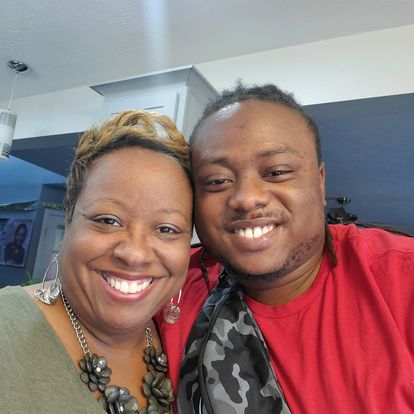
County Coroner Copes with Loss of Son
Part One
By Luke Schmaltz, VOICES Newsletter Editor
For most people, grief and loss are infrequent events which occur outside of the normal range of everyday experience. Yet some people contend with death daily such as hospital staff, first responders, and those who work in the county coroner’s office.
Alfie McGinty has been working in the Marion County, IN Coroner’s Office for the last 28 years, serving 18 years as Chief Deputy Coroner. In November 2024, she was elected as Coroner of Indianapolis, a position she took over in January.
Her experience with grief and loss is not only ongoing due to the parameters of her work, but she is also bereaved by the death of her son, Jimmy, who died of substance-related causes in 2021.
Ubiquitous Loss
"I've seen a lot,” McGinty begins. “I’ve had a lot of experiences surrounding death, working with families, and conducting death investigations – everything from natural deaths, sudden unexpected deaths, homicides, suicides, accidents, substance-related deaths, and everything in between.”
“From my experience, I always try to lead with compassion because none of us can say the day when it is going to happen to us. Most importantly, I have found that families have a difficult time when they lose a loved one.”
“I’ve had my own experience of loss,” McGinty continues. “On July 24, 2021, I was called in the early afternoon by one of my deputies. I was a little busy, as I was getting ready to go set up my food truck at the Indiana State Fair. My deputy asked if I knew a James Williams. I explained that I knew three people by that name. I asked, ‘How old is this James you are talking about?’ She said, ‘27.’ I screamed and said, ‘No, don't tell me he is dead.’ She said, ‘Yes, he is. I am so sorry.’”
Magnified Struggle
“Jimmy had struggled with substance use for about four years prior to this. He and I had been on a journey together during that time. At that point, I broke down, and I became one of the families that was notified by our office about the death of a loved one.”
“In fact, I was one of 800 families that was notified that year that a loved one had died due to a drug overdose. We saw the numbers increase every year from 2014 to 2023. Year over year the statistics were increasing by 20 to 30 percent.”
“Prior to that, I knew there was a problem impacting our communities and I worked on various teams to try and look into what we could do to prevent those deaths from occurring. At the same time, I was dealing with the crisis at home as Jimmy struggled with substance use. We worked very closely together to get him the help that he needed.”
A Unique Situation
“Jimmy and I were very close,” McGinty continues, “So he would always let me know when he was struggling. We celebrated the good times of sobriety and endured the times of insobriety. The struggle is real; it is like watching your child die while they are still alive and there is nothing you can do to prevent it – to not watch them suffer.”
“Because of this, I knew what I was seeing at work. I often call it a clash of work and home. I dealt with it every day at work as well as at home. It put me in an incredibly unique situation. As Coroner, I was conducting death investigations into drug overdoses three or four times a day to then going home and sharing this information with my son. I explained to him that there are lethal drugs in the supply chain called fentanyl and he could potentially ingest them and doing so could cost him his life.”
“Going through the loss put me in a totally different category. I still had to come to work and deal with people who were losing their loved ones while coping with my own grief.”
Finding Support
As someone who deals with death every day, McGinty initially thought she would be fine without grief support. “Within about a month,” she says, “I knew I was not OK. I knew it was going to be much harder, although I thought I had prepared myself. I felt like I was going to break.”
“I turned to an organization called Overdose Lifeline, based here in our city. Ironically, the organization’s founder, Justin Phillips, had a son, Aaron, who also died from an overdose. He played on the same football team as my son, Jimmy. So, I have known her for a very long time because our boys went to high school together. Aaron was the quarterback, and Jimmy was the running back. I reached out to Justin, and she invited me to a grief support group.”
“The grief support group helped me in processing all the pain and grief and allowed me to let those feelings out in a safe space with others who knew the pain I was going through. Outside of that, I continued to go to the other grief support groups she held which were related to overdose fatalities.”
Annual Self-Care
McGinty is mindful of the cyclic nature of grief, especially when it comes to the month of July, around the date when Jimmy died. “That whole month is a terrible black hole,” she says. A couple of weeks before that first July anniversary came around, Justin from Overdose Lifeline asked me, ‘Do you feel like you are walking the road to death?’ I said, ‘Yes, I do but I am not going to let it take me down.’”
Luckily, every third week of July, McGinty has a conference to attend to, so there is a bit of a respite she can lean into during the anniversary of Jimmy’s death. “It helps because it is work-related,” she explains, ‘And my workaholic-ness gives me something to dive into.”
“There is something I have started doing for the past two years,” McGinty continues. “When I am in Las Vegas at the conference, I take that entire day off and go to the spa. It is a day I absolutely hate because there is something about it that I just can’t let go of. It won’t let me leave it alone. I take a self-care day. Instead of letting it control me, I use that time to take care of myself. I am already tense, I am already anxious, I am already dealing with a lot mentally, so going to the spa lets me focus on relaxing my body and mind. I set up meditation and yoga while there as well, and it does my heart good because Las Vegas was one of Jimmy’s favorite places.”
“Self-care is important because I do carry guilt around it all. But I collected all the text messages Jimmy sent me that say, ‘I love you, Mom.’ I have them all in a nice, beautiful portrait on my phone. So, I pull it up and remind myself that he loved me so much. That’s what I look at all day on my spa day, and I remember him with tears because I miss him. But I also remember that I had a special kind of love with this child and I cherish the fact that I had the opportunity to experience it.”
Look for the Light
“If there is a way that families can look at anything positive about their lost loved ones, it can help get through those difficult grief days,” McGinty says. “Sure, Jimmy and I had a lot of bad days, but we had so many good days for which I am so grateful. So I reach to that, knowing that Jimmy would have loved for me to be at the spa, he would have loved for me to have a self-care day, he would have loved for me to be looking at all of his text messages of loving messages, crazy memes, and pictures of us with funny faces.”
“I talk to so many families who are grieving, and I share with them that I lost my son, so they understand that I am not showing up as this elected official who has no clue about grief. I come to them from the standpoint of someone who knows this pain. I encourage them to draw on their positive memories and experiences with their person, regardless of how they died, because grief is going to be there.”
“Oftentimes, parents, family members, and siblings who are struggling with grief call our office for help. When this happens, my staff knows to send them to me so that I can share with them the things that have helped me that may be able to help them as well. I tell them, ‘Pull on all your positive experiences and good memories with your loved one and hopefully it will put your heart in a different space. It will help you get up and just put one foot in front of the other – knowing your loved one would have wanted that for you.”
Part Two of this story will explore Alfie McGinty’s experiences with enhanced grief support, stigma and community, harm reduction, substance-use awareness, and more. Please stay tuned to the December issue of VOICES for the rest of the story…