
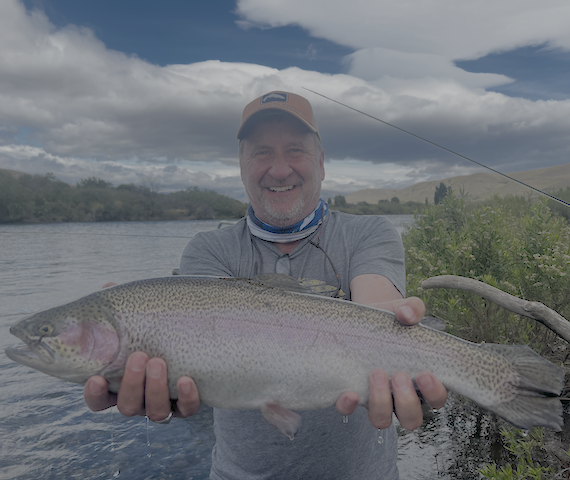
Fly Fisherman Heals in the Present
By Luke Schmaltz, VOICES Newsletter Editor
Jim Faust is the founder of Adam’s Parachute, a therapeutic fly fishing program tailored to people in recovery and those who support them. He subscribes to the meditative and therapeutic aspects of fly fishing as he copes with the loss of his son, Adam.
Faust named his program after his son, who was dedicated to supporting people struggling with substance use. During his two years of recovery, Adam helped dozens who were on the cusp of a relapse. The night before he died from an accidental overdose, Adam saved someone else’s life.
Faust is a retired physician and anesthesiologist. “I took care of a lot of people who had heart failure, cancer, or diabetes,” he says. “People who get treated for those conditions don’t go out looking for others with the same diagnoses to offer them help. Recovery is different. It is a community of clients and healthcare workers I am in awe of. They are in a battle which they must fight every day of their lives.”
Struggle and Balance
“Adam’s opiate addiction began the way many do,” Faust says. “He had three operations for chronic wrist pain. At 14, he was given a prescription for opioids; large doses and multiple refills is how it all started.”
“It is still pretty fresh for us. It has only been seven months since Adam died,” Faust says. “Adam had just celebrated two years of sobriety. He relapsed once after his first run through rehab, and he went right back in. He was two years and two months sober when we lost him.”
“When he was in recovery, Adam worked in the addiction recovery community. People in recovery are uniquely drawn to helping other people who are in their situation. He first worked as a case manager and then as a business development officer. He was very good at it.”
Devotion and Tragedy
“Adam made himself available to clients 24/7,” Faust says. “He always had his phone on, and he never said no. He worked full time and easily an extra 20-30 hours a week. If a client or a client’s family member called with a situation, he would get in the car, drive out, and spend time with them. He was deeply devoted.”
“Adam carried a quote in his car by Albert Schweitzer that said, ‘The purpose of human life is to serve, to show compassion, and the will to help others.’ That’s the way Adam lived his life. He saved a lot of people’s lives. We have a basket of 40 or 45 letters from people thanking Adam for saving them.”
“My wife and I would often tell him that he needed to have balance in his life – that he needed to be mindful of not working himself to death. ‘You can’t help everybody,’ we would say. He said, ‘Yeah, but I can help everybody who crosses my path.’ That’s what he did, and he died doing it. He was an amazing human being, a wonderful son, and a great friend.”
“The night before he died,” Faust continues, “Adam got a call that someone had left a recovery program, got in trouble, and was being held at a police station. If someone could go pick them up, the police would not press charges. He drove an hour away to pick up the young man and stopped at a convenience store on the way back.”
“The guy went into the store while Adam waited. When he didn’t come out, Adam went inside looking for him. The bathroom door was locked, and Adam broke it down. The guy had overdosed, and Adam administered Narcan and CPR and saved his life. Adam died the next morning.”
Despair and Hope
“Some folks have to hit the bottom of their lives before they start fighting. I hit the bottom of my life in July 2024 when we lost Adam. I know how hard it was for me to stand up. Anyone who gets that far down and finds the strength to stand up has my respect.”
“I also respect people who are using their skills to help others – people like Dave Swindell from The Sun Will Rise. Two weeks after Adam died, I contacted them for support. My head was spinning. I was barely standing. They have been great to me; I have made some good friends there. Some of them are almost like sponsors.”
“When we lost Adam, my wife and I and our other son, Brian, started this journey. I’ve learned a lot about grief. Every experience is unique, including mine. Whenever you endure something difficult, horrible, or life-changing, you are put in a position to use the empathy that comes with experience to help other people.”
“Peer support is huge. People who facilitate these groups are qualified by what they have been through. What they offer is the ability to listen. Even though it is small, there is a little bit of healing that occurs every time I tell Adam’s story. It’ll never end, that’s for sure, but it is nice to feel a little bit of healing.”
Therapy and Outreach
“There’s something therapeutic about tying flies,” Faust says. “Even if you never use them. It’s nice to sit at a quiet table at night with a light and work with the various materials.”
“The name Adam’s Parachute is a tribute to my son and is also the name of a fly that imitates mayflies,” Faust explains. “Adam gave his parachute to someone else. He did that all the time.”
“The mission of Adam’s Parachute is to bring the therapeutic effects of fly fishing to people in recovery and those who work in the field. It has been shown to decrease PTSD, decrease anxiety, decrease depression, improve sleep quality, and improve one’s ability to be in the moment. I wish Adam had fished more. Maybe he would have lived longer, I don’t know.”
“There are a dozen-or-so organizations across the country such as Casting for Recovery for women with breast cancer and Project Healing Waters for disabled veterans. I volunteered with Project Healing Waters for a couple of years after I retired. We taught fly fishing and fly tying to vets, and we fished with them. You take someone with PTSD who has a lot of difficulty in everyday situations, you get them out to the water, and it is like adding oil to the Tin Man. They begin to relax, smile, and have fun.”
A Novel Idea
“Before Adam’s Parachute, nobody had introduced the therapeutic benefits of fly fishing to the recovery community. I couldn’t find it anywhere. Our job is to find our passion and use it to help as many people as we can. I intend to continue Adam’s Legacy of helping people who are in recovery by connecting with them through fly fishing.”
“The way it works is, I reach out to a PHP (Partial Hospitalization Program), an IOP (Intensive Outpatient Program), or a sober home and I tell them what I do. I ask if they are interested in having me meet with their clients every other week. Six weeks after taking that initiative, I was all booked up.”
“Monday through Friday, every other week, I travel to these programs and teach tying knots, tying flies, and casting techniques. I teach the general feeling of loading the rod and throwing a fly line. I can have some of these folks up to snuff by the time fly fishing season comes around.”
“The very first time I meet with people, they tie a fly. I give them all sorts of artistic leeway and plenty of materials to work with. I started this in September 2024, so getting people out fishing is a work in progress. I have a lot of contacts in the Massachusetts fly fishing world. I will be getting these folks out fishing as much as I can later this year.”
Mindful Moments
“If you believe in mindfulness and that healing happens in this moment – not looking at the past and not fretting about the future – fly fishing is amazingly helpful. So is fly tying. It is hard to think about the past or the future when you are tying a fly or engrossed in the activity of fishing.”
“You look upstream and that’s the future. You look downstream and that’s the past. You’re not going to catch fish in those places. You must be laser focused on what is right in front of you. You’re going to land the fly where it needs to go, try to give it that perfect drift, and follow it along the water. If no fish strikes, you yank it out and recast it back into the place in front of you. It is a healing process.”