
Massachusetts Communities Receive Opioid Settlement Funds
Part Six
By Luke Schmaltz, VOICES Newsletter Editor
Over the next decade-and-a-half, over $1 billion will be distributed to 351 municipalities across Massachusetts. Payments from corporations such as Johnson & Johnson, Purdue, Allergan, Teva, CVS, Walgreens, and Walmart are allocated to each community based on recent per-capita rates of opioid deaths.
Previous installments of this series have examined how communities in the eastern and western parts of MA are accessing funds from recent settlements with opioid retailers, distributors, and manufacturers. This story focuses on the unique challenges of Springfield, MA, which will receive $7.2 million in installments through 2038 under the State-Subdivision Allocation Agreement.
Each region and township faces a specific set of opioid-related challenges. Accessing the settlement funds relies on how successfully community leaders can work with local government officials to determine how and where the monies can have the greatest impact.
Spend it Forward
In April 2022, Springfield Mayor Domenic J. Sarno announced that his office, in a joint effort with the City of Springfield Finance Department, would be committing over $421,000 from the FY23 budget to a diverse set of initiatives in response to the opioid crisis. This was done in advance of having access to the settlement funds which were temporarily inaccessible due to a legislative oversight at the state level. This was accomplished by passing special state legislation – an amendment to Massachusetts General Law Chapter 44, Section 53 – by creating a general fund revenue exception.
In a concurrent press release, Sarno stated, “We can’t wait and must continue to hit this epidemic head on, while also advocating for more treatment beds here in Springfield and Western Massachusetts. The COVID-19 pandemic has created an opioid, drug and mental health epidemic.”
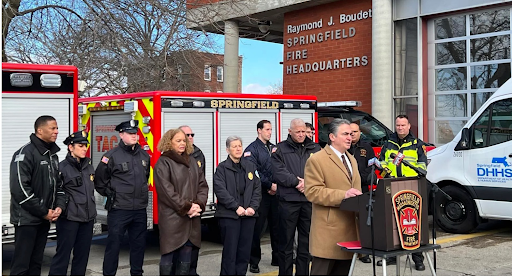
These funds were earmarked as supplemental resources for the Department of Health and Human Services, the Springfield Fire Department, and the Springfield Police Department. Tangible resources purchased included a Mobile Medical Response Vehicle, two full-time tactical vehicles assigned to Fire Headquarters and White Street Fire Station, 200 medical bags with 300 tourniquet kits, 30 automated external defibrillators with batteries and Narcan pouches, and 400 Narcan pouches for officers and first responders to carry in the field.
Currently, the lawsuit settlement funds are held in the city's general fund. Meanwhile, the Springfield City Council Finance Subcommittee is tasked with balancing the mayor’s preemptive expenditures with these now-accessible monies.
Community Concerns are Heard
Helen Caulton-Harris is the Commissioner of the Division of Health and Human Services for the City of Springfield. In a May 6, 2024 City Council Meeting, she presented statistics that emphasized the immediacy of the crisis. “In 2014, there were 31 opioid-related deaths. In 2021 there were 119,” she said.
Caulton-Harris’ presentation was to support her office’s proposal that $1,521,535 be transferred from the General Fund (free cash) to the Opioid Settlement Account so that she and her colleagues could implement their Overdose Response Plan. “It is critical that we transfer this money. We cannot do any work until we have the money to pay for the work,” she explained. “I anticipate and hope the city will put out a structured RFP (request for proposal) process and have individuals respond in a way that fills those gaps that have already been identified.”
In her presentation, Caulton-Harris also outlined the opioid crisis-related needs and concerns of the community. The supporting data for her presentation was compiled via online surveys, interviews with active users and people in recovery, families of people in recovery, and state-resourced statistical data. “I want to read to you a few things we have heard from the community,” she began. “We heard about stigma, structural racism, poor communication between agencies, and lack of awareness of available services for navigating the system. We also heard about clients not getting correct services or referrals, care coordination being poorly informed about substance use treatment, and the bottleneck of post-care and detox.”
“Not enough people in active addiction are involved in the decision-making process,” she continued. “There are no overdose prevention (safe injection) sites in Springfield. There are limited numbers of halfway house beds, long waits in emergency rooms, long waits for inpatient beds, no consistent buffer programs, no overnight drop-in centers, a lack of treatment centers, no structural referral system, and no standardized training.”
“This is an opportunity for the city to create something that will potentially outlast all of us in terms of a plan that could be updated. We are trying to create a system of care that looks at an individual primarily, at their substance use disorder, [before] asking how we treat them as far as systems are concerned. The other piece is, how do we reach our young people?”
Caulton-Harris also outlined how her agency and other local organizations can align in their collective effort to reverse the city-wide crisis. “There are those [agencies] who currently have funding to do some of this work and we are hopeful that we match their funding, so that we make stronger programs and better outreach. The other piece is, there are organizations that are not specifically tied to funding for opioids – childcare, public transportation, and case management. How do we include a family in the treatment of an individual who has a substance use disorder, who is ready and wanting to not stay addicted?”
The Springfield City Council voted unanimously in favor of Caulton-Harris’ proposal, with numerous council members endorsing the commissioner’s longtime work in the community.
A Citizen Speaks Out
Stephen Howard is a resident of Springfield, taking part in community outreach, city council meetings, and serving on the board of the McKnight Neighborhood Council. Over the last year, Howard has kept a keen eye on the unfolding discussion between his fellow residents, local officials, and other stakeholders in how the opioid funds will be utilized to address a community deeply affected by the ongoing crisis.
“My increased interest in the allocation of funds was triggered by the Springfield City Council's meeting on 12/18/23, Chaired by its outgoing president, Jessie Lederman,” Howard explains. “I attend these meetings out of curiosity – to find out what is going on. I have seen numerous people pass out – luckily they have all recovered – so this has become very personal to me.”
Howard notes that the $1.5 million transfer of funds requested by Commissioner Caulton-Harris took a considerable amount of time to be approved by city council. “It took them about five months to figure out what was going on before they decided to transfer the funds,” he says. “I had information, which others in these meetings did not have about how many opioid deaths there were in the Springfield area last year. There were 104 deaths, and I got the information by simply doing a search. Currently, we are averaging two deaths a week.”
“From the research I am doing, I am finding out that in many municipalities, the money is just sitting there because people don’t know what to do with it. It is important that the money is distributed to the communities that are in most need of support and that those monies don’t end up in more affluent areas that have the resources to address the crisis.”