
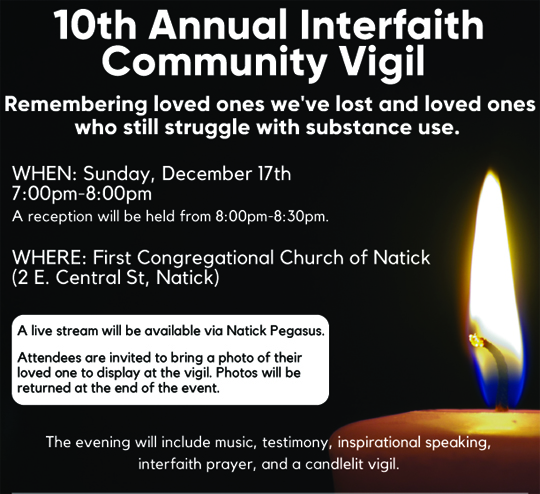
Grieving Families Connect Through Interfaith Vigil
By Luke Schmaltz, VOICES Newsletter Editor
Catherine “Katie” Sugarman is the Prevention and Outreach Program Manager for the Town of Natick Health Department.
For the last 10 years, Sugarman’s organization has hosted the Interfaith Community Vigil for honoring those who struggle with and those who have died from substance use.
“It is an event that we continue to feel strongly about making happen every year,” Sugarman says.
Event Origins
The event was inspired by one of Sugarman’s previous employers in Revere. There, she saw firsthand how a vigil can bring a community together to recognize the opioid crisis. “It became an event to not only grieve and remember those we had lost, but to also support families who were missing a loved one. It created an opportunity for people who felt isolated to come together and connect with others who have been impacted. It started to lift some of the cloak that had covered this issue for far too long and it allowed people in that community to publicly recognize how many families had been affected.”
“I started working in Natick in December 2013,” Sugarman continues. “In February of 2014, the community lost a couple of young adults to overdose. They were from families that were well known, and the losses happened in rapid succession – within a couple of weeks of each other. At the funeral home on Natick Common, the lines of supporters wrapped around the building . Those losses really shook a lot of people in town who knew overdose happened but had their own ideas of who dies by overdose. There was a lot of stigma and preconceived notions ten years ago, that people hopefully don’t subscribe to as much today, but the fact is, anyone can die of overdose.”
“March of 2014 was the first time we decided to pull together a vigil. We opened it up to the community and I was struck by the number of phone calls I got. It became an opportunity for people to show up and say, ‘This has been going on for so long and no one is talking about it.’ It became the first public acknowledgement of how deep and pervasive this issue was in the community.”
Grassroots Outreach
“At that first vigil, we advertised that we were going to host our first Narcan training and we encouraged folks to come back for that. It was the beginning of a trickle effect of more people recognizing that they could reach out to Natick 180 if they had questions or wanted to get involved. Some of the families who met each other through those events started to create their own support groups and nonprofit organizations to support families going through the process of loving somebody who experiences substance use disorder.”
“That same year, we held another vigil in December. We felt like the holiday season is such a tough time for so many of us, especially if you are missing somebody from your table.”
The event serves as an unofficial follow-up to International Overdose Awareness Day on August 31. “There are plenty of vigils around that time, but there aren’t many during the holiday season,” Sugarman explains, “When we just need to hold each other tighter and support each other a little bit more because it is a tough time of year for those of us who are grieving. This type of an event creates an opportunity for people to connect with each other.”
Strategies for Connection
“There are so many strategies we need to pursue around overdose prevention such as early intervention, better treatment, and better recovery support. But the personal connection that comes from hosting these kinds of vigils is how those strategies flow out into the community – connections between caring concerned individuals who are there because they have lost a loved one to substance use or they are supporting someone who lost somebody.”
“We are fortunate that the Natick Interfaith Leaders Association is central to the planning and hosting of the event,” Sugarman explains. “We try to make it as ecumenical as possible so that there are multiple faith traditions represented. This is a time of year when many faiths are celebrating various holidays, so the event is not religious in nature, but is spiritual in a sense.”
Close to Home
Sugarman was inspired to work in the substance use prevention field through direct experience. Like many, several members of her family have struggled with this issue. “Once I started doing substance use prevention, I started to learn about the opioid crisis. I have gotten to know so many families here in Natick personally. I get very emotional when I think of some of the families who got into this work because they were trying to support a child or a loved one who was struggling with addiction. Some of those families have had to bury some of those loved ones.”
“I was just on the phone with a family who lost their son a year ago on November 25. The mom had reached out to me to get information about this year’s vigil. I said, ‘I’m so sorry for the reason why you’re going to join us this year, but I look forward to being with you so that we can remember your son together.’ She got very emotional on the phone and said, ‘My son was at the table last Thanksgiving and said that we should go to the vigil together.’”
A couple of weeks later, her son had died, and she came alone to the vigil.
“Families like that have been so kind to be vulnerable with me and share those stories. I feel a strong commitment to make sure this event continues to create a space for them – to hopefully bring them some comfort and help them connect with others who understand what they have been through.”
Meeting the Challenge
The rewards of Sugarman’s work are bittersweet, yet she remains steadfast in her commitment to support those in the community who are struggling with loss. “As an organization that is trying to improve access to resources and improve outcomes, every time we lose someone it is hard to not feel like we have failed that family.”
“Addiction is a very complex disease and there is no one thing that contributes to a loss. It makes me feel all the stronger about the fact that we have to work harder and dig deeper to prevent these losses.”
To find personal balance amid her challenging role, Sugarman cites physical activity, personal time, family time, and prayer as effective strategies for self-care. “Being outside is my greatest cathedral to pray in. If I can go for a walk or a hike, that is always restorative for my soul. I am incredibly blessed to have a family that keeps me grounded. I am often the face of this work because I am coordinating a lot of the things that go on, but I am not on the front lines the way that our first responders, clinicians, and harm reduction specialists are. I remind myself of the burdens others are carrying in this fight that are much heavier than mine.”
The 10th Annual Interfaith Community Vigil will be held at the First Congregational Church of Natick on December 17 from 7:00 p.m. to 8:00 p.m. For more information, call 508-647-6623 or email [email protected].